Physical and Theoretical Chemistry
Polymers and Soft Condensed Matter
Dr Edith Sevick
 In the past decade, Atomic Force Microscopy (AFM) and Optical
Tweezers (OT) have revolutionised molecular science by measuring
picoNewton forces over lengthscales from 1 to 104
Angstroms. In our laboratory, we have an Optical Tweezer Apparatus
which has been extensively modified for our force measurement
experiments in polymer and colloids science. The apparatus consists
of an optical trap that weakly “holds” a micron-sized
bead. The trap is formed by a focused laser beam that is refracted
through the transparent bead. The refracted rays differ in intensity
over the volume of the colloidal bead and exert a force on the bead,
drawing it towards the region of highest light intensity. The optical
trap is harmonic near the focal point: the optical force acting on a
colloidal particle positioned at x from the trap centre is
Fopt=-kx, where k is the trapping constant which can be
tuned by adjusting the laser power. In this way, the optical trap
generated by the OT serves to both localise a colloidal particle and
to measure the small, sub-picoNewton scale forces acting on the
particle. With substantial modifications, our OT apparatus probes
forces at small lengthscales and over small timescales that are
necessary in studies of nonequilibrium statistical mechanics and
polymer/biopolymer science.
In the past decade, Atomic Force Microscopy (AFM) and Optical
Tweezers (OT) have revolutionised molecular science by measuring
picoNewton forces over lengthscales from 1 to 104
Angstroms. In our laboratory, we have an Optical Tweezer Apparatus
which has been extensively modified for our force measurement
experiments in polymer and colloids science. The apparatus consists
of an optical trap that weakly “holds” a micron-sized
bead. The trap is formed by a focused laser beam that is refracted
through the transparent bead. The refracted rays differ in intensity
over the volume of the colloidal bead and exert a force on the bead,
drawing it towards the region of highest light intensity. The optical
trap is harmonic near the focal point: the optical force acting on a
colloidal particle positioned at x from the trap centre is
Fopt=-kx, where k is the trapping constant which can be
tuned by adjusting the laser power. In this way, the optical trap
generated by the OT serves to both localise a colloidal particle and
to measure the small, sub-picoNewton scale forces acting on the
particle. With substantial modifications, our OT apparatus probes
forces at small lengthscales and over small timescales that are
necessary in studies of nonequilibrium statistical mechanics and
polymer/biopolymer science.
Probing Thermodynamics of Small Systems over Small Timescales
using Optical Tweezers
The
puzzle of how time-irreversible microscopic equations of mechanics
lead to the time-irreversible macroscopic equations of thermodynamics
has been a paradox since the days of Boltzmann. Boltzmann simply
side-stepped this enigma by stating “as soon as one looks at
bodies of such small dimension that they contain only very few
molecules, the validity of this theorem [the Second Law of
Thermodynamics and its description of irreversibility] must cease.”
Today we can state that the Fluctuation Theorem, first proposed by
Denis Evans and colleagues in 1993, is a generalized, Second-Law like
theorem that bridges the microscopic and macroscopic domains and
links the time-reversible and irreversible descriptions. The
predictions of the FT should be relevant to many nanotechnological
applications. Our work in 2003 had three major themes:
Experimental Demonstrations of the FT
The first experimental demonstration of the FT was achieved only in
2002, in a joint collaboration between the Evans and Sevick groups.
We continue to demonstrate experimentally the FT predictions using a
modified OT to measure picoNewton forces acting on a colloidal bead
over nanometre to micron distances. Last year, we demonstrated an
integrated form of the Transient Fluctuation Theorem (ITFT) through
analysis of trajectories of an optically-trapped colloidal particle
subject to solvent flow field. This was the first experimental
demonstration in the FT field and it received considerable
international press. This year, after further modifications to the
OT, we demonstrated directly the Transient Fluctuation Theorem
(TFT), for the first time, using the “capture” experiment.
The experiment follows the transient trajectories of a colloidal
particle in a stationary optical trap whose strength changes
discontinuously. Unlike our previous experiment, the measured
averages of the dissipation function also agreed with analytic and
numerical predictions of the Langevin equation.
(with D.M. Carberry, J.C. Reid, G.M. Wang, D.J. Searles
[(Griffith U.], and D.J. Evans)
Stochastic Descriptions of the FT
The argument of the FT is the dissipation function, which is a measure of
the system’s irreversibility. It was originally defined for
deterministic, Newtonian equations of motion or “detailed
balance”, but has been applied inconsistently to systems where
the relevant time/length scales are too large to be simulated using
Newtonian dynamics. In 2003 we presented a definition for a
stochastically-derived dissipation function for systems described by
stochastic, Langevin dynamics. We demonstrated this
stochastically-derived dissipation function in experimental analyses
and showed that, for a given system, there can be “different”
forms of the dissipation function that obey the FT.
(with J.C. Reid, D.M. Carberry, G.M. Wang, D.J. Searles [(Griffith
U.], and D.J. Evans)
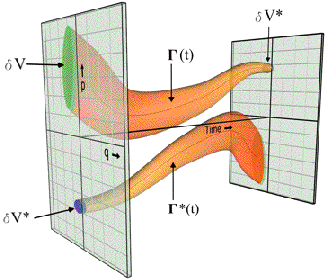
An illustration of a set of neighbouring Newtonian trajectories
initiated in a volume element δV (top tube) and corresponding
set of
anti-trajectories initiated in δV* (lower tube) in
coordinate-momentum (q,p) and time, t, space. For every
trajectory Γ(t) initiated
in δ, there exists a
time-reversed or anti-trajectory Γ(t)* that is initiated
in δV*. The ratio of the probability of observing trajectories
initiated within δV to those in δV* is a measure of the
system’s irreversibility.
Kawasaki Identity and the FT
We have shown that the FT implies that the Kawasaki function is
equal to unity. More importantly, we demonstrated that deviation of
the Kawasaki function from unity can be used as a diagnostic tool in
simulation and experiment, indicating the quality of the sampling of
data.
(with D.M. Carberry, S.R. Williams, G.M. Wang, and D.J. Evans)
Optical Tweezers for Biopolymer Studies
By attaching specially-coated latex beads to the ends of modified
DNA, we are able to use an optical trap and micropipette to stretch a
single bead-DNA-bead assembly and to construct a force versus
extension profiles of several DNA systems. These force profiles are
used to study the effect of different salts and the interactions of
specific binding proteins on DNA. In 2003 and in conjunction with the
Protein Synthesis and Evolution Group headed by Nick Dixon, we focused
upon different end-tethering techniques so that we can efficiently
stretch ds-DNA where one strand is linked to the beads, and
where both strands are linked to the beads.
(with G.M. Wang, D.M. Carberry, P. Schaeffer, and N.E. Dixon)
[
Sevick Group |
RSC Annual Report Index ]
Last revised 18 April 2004 -
Please direct all enquiries to:
Research School of Chemistry
Authorised by the Dean, RSC as relevant officer.
©
2004 The Australian National University
CRICOS Provider Number 00120C